Buying a building in Spain: technical due diligence
What to check before buying a whole building in Spain: documents, structure, the IEEV.CV report, services and planning status, with a findings table.
· 14 min read · Teciforp
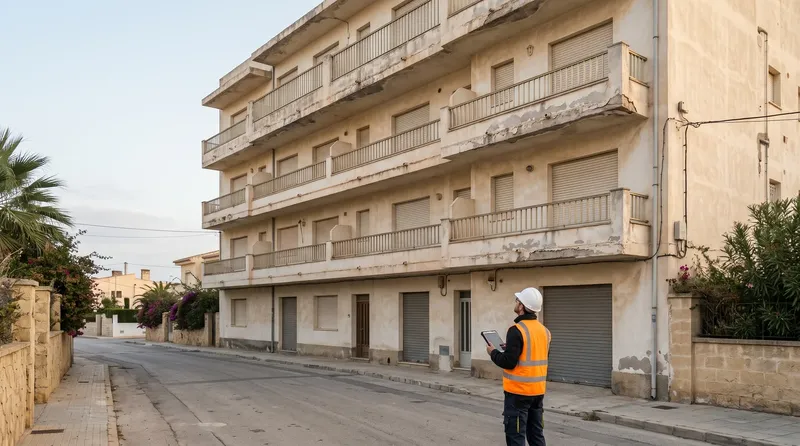
Before you sign a deposit contract (contrato de arras) on a whole building in Spain, have five things checked, in this order: the paperwork, the structure, the facades and roof, the building services and who occupies the property. A building survey is not a standard step in a Spanish purchase and no rule obliges the buyer to commission one, so it is easy to skip. Yet two of the five — structure and planning status — can make a renovation or a hotel conversion unviable. This is the technical due diligence to run before buying a building for renovation in the Valencia region (Alicante, Benidorm and the rest of the Costa Blanca), with the document to request at each step and the rule behind it.
How a Spanish purchase differs from what you know
Three differences matter to a buyer from abroad.
There is no surveyor in the usual sense. Building surveying is not an accredited degree in Spain; technical due diligence is carried out by architects and technical architects (arquitectos técnicos), usually with a structural or services engineer, as the RICS Built Environment Journal explained in 2022. The same article notes that Spain has no compulsory third-party check comparable to UK building control and that some works are authorised by a responsible statement (declaración responsable) rather than a full licence, so the licence history of a building has to be verified, not assumed.
An old building is sold as seen. The statutory liability periods of the Building Act (Ley de Ordenación de la Edificación, LOE) — ten years for structural damage, three for habitability defects and one for finishes — run from the handover of the original works (Article 17 LOE). In a building from the 1960s or 1970s they expired decades ago.
You inherit the seller's planning position. The new owner steps into the previous owner's planning duties (Article 27.1 of the Land Act). A pending repair order or an unlicensed extension comes with the title deed.
So the sensible order is: documents first, because they are cheap and rule out many buildings from a desk; then the technical visit; and testing only for buildings that pass both filters.
Step 1. Documents to request before you visit
| Document | Who provides it | What it tells you |
|---|---|---|
| Land Registry extract (nota simple) | Land Registry | Owner, charges, division into units and registered burdens, including municipal repair orders |
| Cadastral certificate with plan (certificación catastral descriptiva y gráfica) | Cadastre | Floor areas and year built; if they do not match the Registry or the building itself, there are extensions to explain |
| Planning guarantee certificate (cédula de garantía urbanística) | Town hall | Zoning and land classification of the plot; issued within one month, valid for up to one year |
| Building evaluation report (IEEV.CV) | Seller | Condition, accessibility and energy efficiency, if the building is residential and over 50 years old |
| Building, occupation and activity licences | Seller and municipal archive | What was built with permission and what was not |
| Original drawings and project; the Building Book (Libro del Edificio) if recent | Seller | Type of structure, spans and original services |
| Energy performance certificate | Seller | The building's energy starting point |
| Tenancy agreements and list of occupiers | Seller | When each flat or unit will be available |
| Maintenance contracts and latest inspections of lifts, electrics and fire protection | Seller | Real condition of the common services |
Three notes on the table.
The planning guarantee certificate is set out in Article 246 of the TRLOTUP, the Valencian planning act: the town hall issues it on request within one month and it is valid for a maximum of one year. Ask for it even if the seller shows you an older report — what counts is today's plan.
The IEEV.CV is compulsory for residential buildings over 50 years old, at least every ten years, and must be entered in the regional register to have administrative effect (Article 189 TRLOTUP). If the building is residential, of that age, and has no report, the seller has an outstanding duty. If it is an office or industrial building, the law does not generally require one, and your own inspection will be the only one.
The Building Book — the project as built, the handover certificate, the parties involved and the use and maintenance instructions — exists for buildings completed under the LOE (Article 7). For older ones, that information has to be rebuilt from the municipal archive and from opening-up works.
Step 2. Structure: the biggest item in the budget
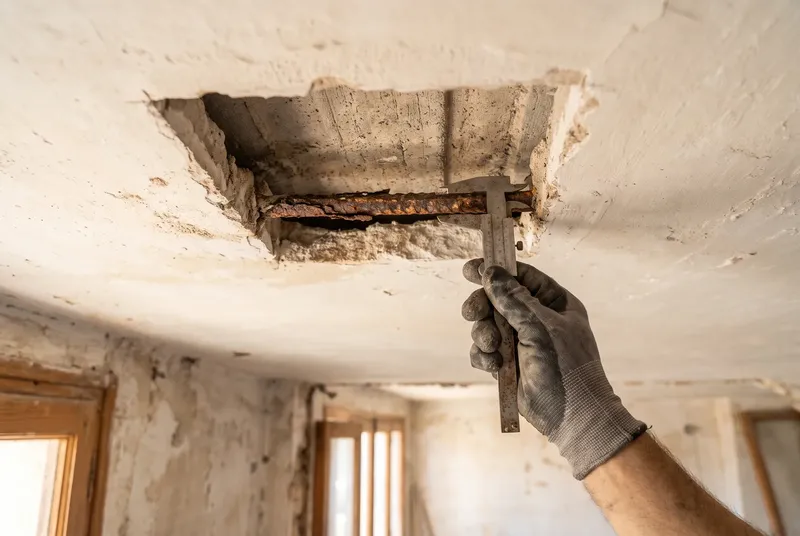
On the Alicante coast, the enemy of concrete is the marine environment: carbonation and chlorides reach the reinforcement, the steel rusts, expands and bursts the concrete cover. You see it on balcony edges, basement ceilings and roof slabs.
On the visit, look for:
- Cracks in slabs and beams, visible deflection and exposed reinforcement.
- Ground-floor and basement columns, where damp is worst.
- Foundation settlement: diagonal cracks in facades and party walls, doors that no longer close.
- Storeys or volumes added later, loading a structure that was not designed for them.
- Openings cut into load-bearing walls in earlier alterations.
If the building passes the visit, commission tests before committing to a price: opening up slabs to identify the joists and their condition, concrete cores, carbonation depth, chloride content, testing old precast joists for high-alumina cement, and locating reinforcement. It is a small cost compared with structural strengthening nobody had budgeted for.
Two rules turn the result into a decision.
The first is use. If you change the building's main use — from flats or offices to a hotel, for instance — the basic requirements of the current Building Code (Código Técnico de la Edificación, CTE) must be met (Article 2.6 of Part I). A structure that is adequate as flats may need strengthening for another use. We cover the process in converting a building into a hotel.
The second is the limit of the duty to maintain. When the necessary works cost more than half the value of an equivalent new building, that limit is exceeded (Article 191 TRLOTUP) and the building qualifies for legal ruin (Article 202). The owner of an unlisted building may choose between renovating and demolishing; in a listed building (edificio catalogado), demolition is not an option. With the test results and a first cost figure, you will know which side you are on before you buy.
Step 3. Facades, roof and damp
According to the insurer Asefa, quoted in the RICS article above, 75% of building defects stem from poor design and workmanship, mainly in waterproofing and in secondary elements such as facades, partitions and finishes. After structure, the money goes where the water goes.
What to check:
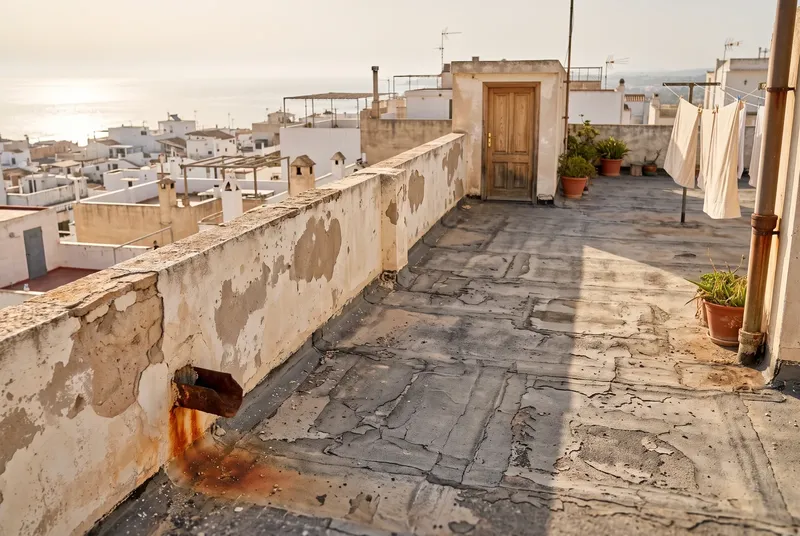
- Flat roof: condition of the waterproofing, junctions with parapets and outlets, stains on the top-floor ceiling.
- Facades: cladding and cornices at risk of falling, slab edges, balustrade fixings.
- Windows and shutters: in a full renovation they are almost always replaced throughout.
- Exposed party walls and lightwells, usually in worse condition than the main facade.
- Basements: water coming through walls and floor slab.
- Fibre cement: roofs, downpipes, tanks and ducts from the years when asbestos was in use.
Asbestos is not only a cost; it is time. Royal Decree 847/2026 of 21 October, which replaces the 2006 rules, requires contractors to identify asbestos-containing materials before any demolition, maintenance or renovation in buildings that predate the ban (Article 10.2) and to work under a plan approved by the labour authority, which has 45 days to decide (Article 12.2). If you locate it before buying, that month and a half goes into the programme from day one instead of appearing mid-works.
Step 4. Building services and utility connections
In a fifty-year-old building the services are replaced in full. What you decide at purchase is whether the building can take the new ones.
- Electricity. Capacity of the existing supply against what the new use will need. A hotel or an air-conditioned apartment building may require a new connection or a transformer room, which takes ground-floor space and depends on the distributor's lead times.
- Drainage. Stacks, collectors and the connection to the sewer; a camera survey if in doubt.
- Water. Pressure, booster set and tank, and room for hot-water plant.
- Lift. Size of the shaft and pit. If there is no lift, or it is not accessible, you need to know where one fits.
- Stairs and escape. Number of staircases, their width and whether they can be enclosed. A change of use brings in the CTE's fire-safety requirements, and adding a second stair core costs floor area on every level.
- Risers and headroom. Without vertical space for ducts and with low floor-to-floor heights, ventilation and air conditioning dictate the whole layout.
Step 5. Planning status: what was built and what is allowed
There are three questions.
Is what stands covered by a licence? Compare the licences with the building, floor by floor. The authority can require unlicensed works to be regularised for up to fifteen years after they were fully completed, and there is no time limit at all on green zones, roads, public facilities, public domain, listed Valencian heritage or non-developable land (Article 255 TRLOTUP). Be careful with the word prescrito (time-barred): once the period has passed, the works are still not legal, and while the breach persists no alteration, extension or consolidation works can be carried out on them (Article 256). For a buyer who intends to renovate, a penthouse added without a licence twenty years ago is still a problem.
Is the building outside the plan (fuera de ordenación)? If the plan says so, only basic maintenance works are allowed; for buildings that are not fully compatible with the plan, it sets a transitional regime that admits alterations and improvements that do not make the mismatch worse (Article 206). When land with buildings in this situation is sold, the deed must say so, and if it does not, the buyer may rescind the contract within four years (Article 27 of the Land Act).
Is it listed? In a listed building the statutory period for deciding a works licence (licencia de obra) is three months instead of two (Article 240), demolition is ruled out, and the project must justify which CTE requirements cannot be met because of the level of protection (Article 2.3 of Part I).
Check too that the municipality has not suspended licences for the use you have in mind: during a suspension the planning guarantee certificate is not issued (Article 246.3). In Alicante, for example, tourist accommodation has its own rules, summarised in can you open a hotel in Alicante under the new rules?.
If the building has tenants
Whoever buys a let dwelling takes the landlord's place for the first five years of the tenancy, or seven if the previous landlord was a company (Article 14 of the Urban Lettings Act), and the tenant has a right of first refusal under Article 25, which also governs sales of several properties together. Ask for every agreement before making an offer and have your lawyer work out when each unit will be vacant: that date sets the start of the works.
What each finding means for the works
| What turns up | What it means on site | How to carry it into the purchase |
|---|---|---|
| Corroded reinforcement or high-alumina cement in slabs | Strengthening or replacing slabs: more time and more budget | Tests before the offer; price adjusted to the strengthening figure |
| Residential building over 50 years old with no IEEV.CV | Outstanding duty of the owner; no public grants for multi-family buildings without it | Seller to provide it before completion |
| Unlicensed works finished less than 15 years ago | Regularise if the plan allows, or demolish | Contract condition, or a discount for the area lost |
| Unlicensed works more than 15 years old | Not legalised by time; they restrict alteration and extension | Value the building without that area |
| Outside the plan | Maintenance only, or whatever the plan's transitional regime allows | Confirm it in the certificate before paying a deposit |
| Fibre cement | Prior identification and a work plan, with up to 45 days for approval | Put it in the programme and the budget |
| Insufficient electrical capacity | New connection or transformer room | Ask the distributor before fixing the use |
| A single staircase and a planned change of use | New escape core and less usable area | Test the layout with the architect first |
| Listed building | Three-month statutory licence period, protected elements untouchable, no demolition | Adjust programme and brief |
| Flats or units let | Works start when they are vacant | Tenancy timetable reviewed by your lawyer |
Taking the findings into the contract
- An offer subject to technical review, with a period of access for the visit and the tests.
- A deposit contract with conditions: a planning certificate confirming the intended use, the structural test results, delivery of the IEEV.CV.
- A price reduction or retention for the items identified.
- A first cost figure and a programme: the two numbers missing from the feasibility study.
After the purchase, the same findings set the order of the design and the works, as described in the stages of a full building renovation.
This article is for information only and is not legal advice: the terms of the purchase contract are a matter for your lawyer.
If you are considering a building in Alicante, Benidorm or elsewhere on the Costa Blanca, call us on +34 602 510 710: with the address or the cadastral reference we can tell you what to check first and whether a technical visit is worthwhile. More on our building search and technical study service.
Frequently asked questions
Is a building survey compulsory before buying a building in Spain?
No. No rule obliges the buyer. What is compulsory is the IEEV.CV, and the duty falls on the owner of a residential building over 50 years old (Article 189 TRLOTUP). A pre-purchase review is your decision, and it is the only way to know the real cost of the works before agreeing the price.
Does the IEEV.CV replace a structural survey?
No. It assesses the condition, accessibility and energy efficiency of a building that stays in use. It does not say whether the structure can take a change of use, and it does not price a full renovation. Treat it as a starting point and add opening-up works and tests.
What about unlicensed works more than 15 years old?
The authority can no longer require them to be regularised, except on the land and assets the law excludes from that time limit, but they are not legal: while the breach persists, no alteration, extension or consolidation works are authorised on them (Articles 255 and 256 TRLOTUP).
Can I demolish the building if renovating it is too expensive?
If it is not listed, yes, with a demolition licence, which has a statutory decision period of two months (Article 240). Before relying on that, check what the plan allows you to build on the plot today: it may be less than what stands there now.
When does an old building have to meet the current Building Code?
When you intervene in it. In an alteration, the CTE applies to the works, with proportionality and no-worsening criteria (Article 2.3 of Part I); in a change of main use, its basic requirements must be met (Article 2.6).
Who pays if structural damage appears after the purchase?
In an old building, in practice, the buyer: the LOE liability periods run from the handover of the original works. What you can claim from the seller depends on the contract and on civil law, which is a matter for your lawyer.
Sources
- Legislative Decree 1/2021, consolidated text of the Valencian planning act (TRLOTUP), Articles 189, 191, 202, 206, 240, 246, 255 and 256
- Act 38/1999 on Building Regulation (LOE), Articles 7 and 17
- Royal Legislative Decree 7/2015, consolidated Land and Urban Renewal Act, Article 27
- Royal Decree 314/2006, Building Code (CTE), Part I, Article 2
- Royal Decree 847/2026 of 21 October on work with a risk of exposure to asbestos, Articles 10 and 12
- Royal Decree 390/2021 on the energy performance certification of buildings
- Act 29/1994 on Urban Lettings (LAU), Articles 14 and 25
- RICS, Built Environment Journal: How to conduct TDD in Spain (9 June 2022)