Can you open a hotel in Alicante under the new rules?
What Alicante's licence freeze allows today and what Amendment 52 to the city plan changes for a new hotel: star rating, zone, building and steps.
· 13 min read · Teciforp
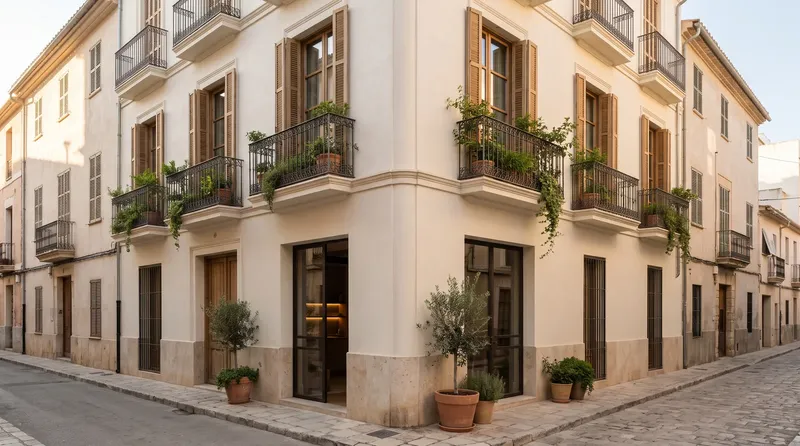
Yes: you can still open a hotel in Alicante. The licence freeze that the city council (Ayuntamiento) approved in December 2024 and extended in July 2025 targets tourist flats (viviendas de uso turístico), blocks of tourist apartments, guesthouses (pensiones) and tourist hostels (albergues); hotels are not among the suspended types. And the rule that will replace the freeze, Amendment No. 52 to the city's General Plan (Modificación Puntual n.º 52 del PGOU), gives 3-, 4- and 5-star hotels their own treatment even in the neighbourhoods it declares saturated. What changes is not whether you can, but where, at what star rating and in what building. Below we put those three decisions in order, from the point of view of the people who then have to carry out the works.
Two caveats first. One: this article reflects the position as at 15 November 2026. Amendment 52 has been approved for public consultation, but we have not found its final approval published, so its figures may still change. Two: this is general information, not legal advice; before you buy or sign anything, request the municipal report we describe further down.
A quick guide to the Spanish terms
If you are investing from abroad, four terms do most of the work in this article:
- PGOU (Plan General de Ordenación Urbana) — the city's general land-use plan. It decides which uses are allowed on each plot. Amendment 52 is a targeted change to Alicante's PGOU.
- Pleno — the full council, the body that approves planning changes. The Junta de Gobierno is the smaller executive board that prepares them.
- Informe de compatibilidad urbanística — a planning compatibility report issued by the city council, confirming whether a given use is allowed on a given property. In practice it is the first municipal filter for any accommodation project.
- Sección censal — a census section, the small statistical area into which a city is divided for population counts. Amendment 52 measures tourist saturation section by section, not by neighbourhood.
Where Alicante's tourist accommodation rules stand
The sequence, with its documents:
- 19 December 2024. The full council suspends planning compatibility reports and change-of-use permits for new tourist flats. The resolution is published in the regional gazette, DOGV No. 10,023, of 13 January 2025.
- 22 July 2025. The full council extends the suspension to blocks of tourist apartments, guesthouses and tourist hostels (DOGV No. 10,159, of 25 July 2025).
- 7 October 2025. The Junta de Gobierno presents the draft of Amendment No. 52 to the PGOU, with the maximum ratios per zone.
- 18 December 2025. The full council opens a 45-day public consultation on it, with 13 votes in favour and 15 abstentions. According to the minutes of that session, once objections and reports from other bodies are in, the file returns to the full council for approval.
- February 2026. An administrative court in Alicante dismisses the tourist apartment association's appeal against the suspension, as reported by ESdiario.
- September 2026. The council maintains that it will approve the final rules before the end of the year, as reported by El Español.
The suspension has an expiry date. The same minutes point out that the Valencian planning law (article 68.2 of the TRLOTUP) sets a maximum duration of two years; counted from the January 2025 publication, the limit falls in January 2027. That is why it makes sense to plan the project now with the rules of Amendment 52 in hand, even though they are not yet final.
Which types of accommodation are suspended and which are not
| Type | Current licence suspension | Draft Amendment 52 |
|---|---|---|
| 4- or 5-star hotel | Not among the suspended types | Not affected by the zone's saturation limit |
| 3-star hotel | Not among the suspended types | Special regime: allowed while the zone stays below 0.32 bed places per resident |
| 1- or 2-star hotel | Not among the suspended types | The council's notes only announce separate treatment for 3, 4 and 5 stars |
| Hostal (small budget hotel) | Not on the published list of suspended types | No exception announced |
| Guesthouse (pensión) and tourist hostel (albergue) | Suspended since July 2025 | No new bed places in saturated zones |
| Block of tourist apartments | Suspended since July 2025 | No new bed places in saturated zones |
| Tourist flat (vivienda de uso turístico) | Suspended since January 2025 | No new bed places in saturated zones; independent access in residential buildings |
The middle column describes what the city council and the local press have published about the two resolutions. The evidence that counts for your property is something else: the planning compatibility report, which is precisely the document the council has stopped issuing for the suspended types.
What Amendment 52 says about hotels

The draft changes the way decisions are made. Until now the question was whether the plan allowed the use on that plot; with Amendment 52 a second question is added: how many tourist bed places there already are around it. Its components, according to the council's note of October 2025 and the minutes of the full council:
- A maximum ratio of 0.187 tourist bed places per resident, calculated per census section and reviewed every year. A section above it is considered saturated and does not accept new bed places.
- 4- and 5-star hotels: the limit does not apply to them, even in a saturated section.
- 3-star hotels: they can be established above the general limit, up to a ceiling of 0.32 bed places per resident.
- Ground floors: tourist uses are excluded from ground floors on main roads, shopping streets and civic axes.
- Residential buildings: any tourist accommodation set up in them needs its own separate, exclusive access, without sharing common areas with the residents.
To put the figures in context: when the draft was presented, Alicante Plaza reported that the ratio for the city as a whole was 0.0733, with 26,299 tourist bed places, and that the saturated zones in the initial proposal included the Centro Tradicional, Casco Antiguo-Santa Cruz, the area around the Mercado Central, Benalúa, Carolinas, Altozano, Campoamor and part of Playa de San Juan. The list that counts will be the one in the annex of zone sheets in the final text, and it changes with each annual review.
The hotel exceptions are not settled. In the council debate one group asked for them to be extended to higher-category apartment blocks and another asked for the ratio to be applied with no exceptions at all, so the article that contains them (article 114 bis of the planning regulations) is one of those that may come out amended.
The arithmetic of one census section
An example with round numbers. Imagine a census section with 1,500 residents:
- The saturation threshold is 1,500 × 0.187 = 280.5, i.e. about 280 tourist bed places.
- The ceiling of the 3-star regime is 1,500 × 0.32 = 480 bed places.
If the section already has 300 bed places, the ratio is 0.20: it is saturated. A block of apartments or a guesthouse would not fit there, but a 3-star hotel does fall within its special regime, because 0.20 is below 0.32. A hotel with 45 double rooms adds 90 bed places and would take the section to 390, i.e. 0.26.
If the section already had 450 bed places (0.30), the same hotel would take it to 540 bed places and a ratio of 0.36. Whether the ceiling is measured before or after adding your project is a detail of the final text that is worth asking about in writing. In that scenario the sensible decision is a different one: design a 4-star hotel, to which the limit does not apply.
The practical consequence is that the star rating is no longer just a commercial decision. In the central neighbourhoods, moving from 3 to 4 stars can be the difference between getting a licence and not getting one, and that determines which building will work for you.
How to open a hotel in Alicante: the order that avoids a bad purchase
- Pin down the property. Cadastral reference (referencia catastral), the planning classification of the plot, the census section it belongs to and whether the façade faces a shopping street or civic axis. With that you already know which row of the table applies to you.
- Request the planning compatibility report for hotel use, stating the intended star rating. It is the first municipal filter and the document that underpins everything else. If you have not bought yet, make the purchase conditional on its outcome.
- Fix the star rating before the outline design. Star classification is governed by Decree 10/2021 of the Consell, the regulation on tourist accommodation in the Valencian Community. Each category requires different floor areas, services and installations, and that decides how many rooms will fit in your building.
- Commission a technical survey of the building if you are starting from an existing one. Turning offices or flats into a hotel is a change of use (cambio de uso), and the Spanish Building Code (Código Técnico de la Edificación, CTE) is clear: whenever the characteristic use of an existing building changes, its basic requirements must be met (article 2.6 of Part I of the CTE).
- Run the numbers with the works included. With the star rating and the survey you can estimate rooms, investment and timescale; we explain how in our guide to the hotel feasibility study.
- Design, licence, works and opening. Then come the design, the building licence (licencia de obra), the works, the opening and the statement of compliance (declaración responsable) filed with Turisme Comunitat Valenciana, the regional tourism authority. The full route is in the phases of a hotel construction project.
The expensive mistake is to reverse the order: buying on price and location, and finding out later that the section is saturated for the star rating in the business plan, or that the building cannot take the works that rating requires.
What the building needs to work as a hotel
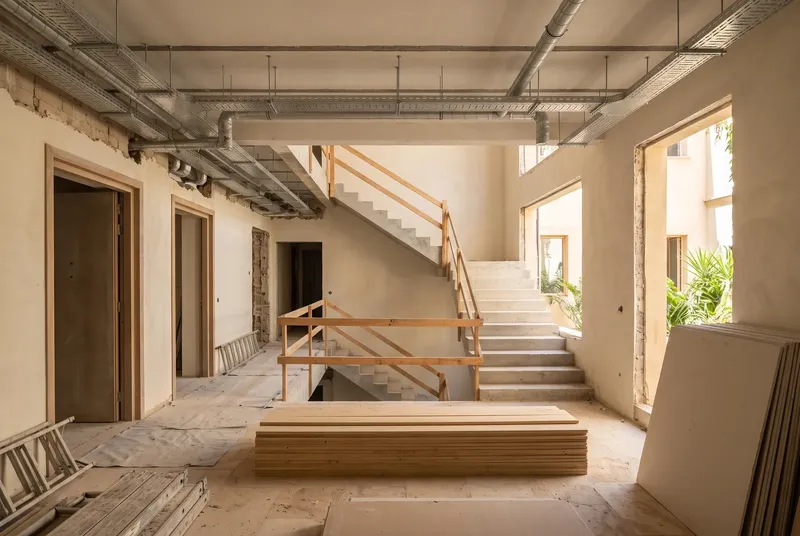
The tourism rules decide whether you can; the building decides how much it costs. This is what we check on a first visit:
| What we look at | Why it matters in a hotel | What it can mean for the works |
|---|---|---|
| Stairs and escape routes | The CTE treats a hotel as Public Residential use in its Basic Document on fire safety, which is stricter than for flats or offices | Protecting or adding stairs, fire compartments per floor, detection and extinguishing systems |
| Accessibility | The CTE requires an accessible entrance, lift and routes, and a quota of adapted rooms | A new or larger lift, ramps, adapted bathrooms, losing a room or two |
| Structure and floor slabs | Bathrooms in every room, plant rooms and rooftop equipment change the loads | Local strengthening, new openings for service shafts |
| Ceiling heights and courtyards | Air conditioning and ventilation need suspended ceilings and vertical risers | Less usable height, rearranged floor plans |
| Acoustics | Adjoining rooms and party walls with neighbours | Wall linings and floating floors, with some loss of floor area |
| Ground floor and façade | Reception, service entrances and, on a shopping street, the ground-floor rules | Reorganising entrances; in a listed building, works subject to conditions |
| Utility connections | Hot water, air conditioning and a kitchen multiply power and flow demands | A new electricity connection or a transformer room |
With this survey and the compatibility report you know whether a building can take a 3-star or a 4-star hotel before you spend money on design. It also explains why much of the recent hotel activity comes through conversion: the 2025 review by the consultancy Colliers, reported by Alicante Plaza, puts hotel investment in the province at 120 million euros and mentions, among the city's projects, the conversion of a former office building on Calle Bazán into a boutique hotel and a plot for a 3-star urban hotel with 97 units.
If what suits your property is not a hotel but an aparthotel, the analysis is similar but the brief changes; we cover it on our page on aparthotels and change of use to accommodation.
If you own a building or a plot in Alicante and want to know whether it can become a hotel, and at what star rating, call us on +34 602 510 710: on the call we will tell you whether it is a job we take on, where to start and what documents to prepare. What we build and refurbish is on our page on hotel construction and refurbishment.
Frequently asked questions
Does Alicante's moratorium stop new hotels?
No. The resolutions of December 2024 and July 2025 suspend licences for tourist flats, blocks of tourist apartments, guesthouses and hostels. Hotels are not among the suspended types. Confirm it for your plot with the planning compatibility report (informe de compatibilidad urbanística).
When do the new rules come into force?
Amendment No. 52 went to public consultation in December 2025 and is awaiting final approval by the full council. In September 2026 the council said it would approve it before the end of the year. The licence suspension cannot last more than two years, so its limit is January 2027.
Can I open a 3-star hotel in central Alicante?
It depends on the census section. The draft allows 3-star hotels above the general limit of 0.187 bed places per resident, but only up to 0.32. In the busiest sections of the centre only a 4- or 5-star hotel may fit, since the limit does not apply to them.
What is a saturated zone?
A census section where the number of tourist bed places divided by its residents is above 0.187. The ratio is reviewed every year, so a section can move on or off the list. No new bed places are authorised in a saturated zone, except under the exceptions provided for hotels.
Can any residential or office building be turned into a hotel?
No. A change of use means meeting the basic requirements of the Building Code for hotel use: escape routes, fire protection, accessibility, acoustics and building services. In some buildings those works take up so many rooms that the project no longer adds up.
Sources
- Alicante City Council, minutes of the full council of 18 December 2025, item I-2.1 (Amendment No. 52 to the General Plan): w3.alicante.es
- Alicante City Council, «Alicante regula los alojamientos turísticos y no concederá licencias en zonas saturadas» (October 2025): alicante.es
- Alicante City Council, «Alicante aprueba en Junta la nueva regulación de usos turísticos que irá a Pleno este mes» (December 2025): alicante.es
- Alicante City Council, «El Pleno aprueba con amplio respaldo la extensión de la moratoria a los bloques turísticos» (July 2025): alicante.es
- Notice of the extended suspension, DOGV No. 10,159, of 25 July 2025: alicante.es
- Decree 10/2021, of 22 January, of the Consell, regulation on tourist accommodation in the Valencian Community: dogv.gva.es
- Royal Decree 314/2006, Spanish Building Code (CTE), Part I, article 2: boe.es
- CTE, Basic Document SI, fire safety, annotated edition: codigotecnico.org
- Alicante Plaza, «Los límites a los pisos turísticos en Alicante: estos son los barrios saturados y cómo será su aplicación» (8 October 2025): alicanteplaza.es
- El Español, the council's tally of enforcement cases and timetable for the rules (24 September 2026): elespanol.com
- ESdiario, court ruling on the licence suspension (27 February 2026): esdiario.com
- Alicante Plaza, hotel investment in 2025 according to Colliers (18 January 2026): alicanteplaza.es