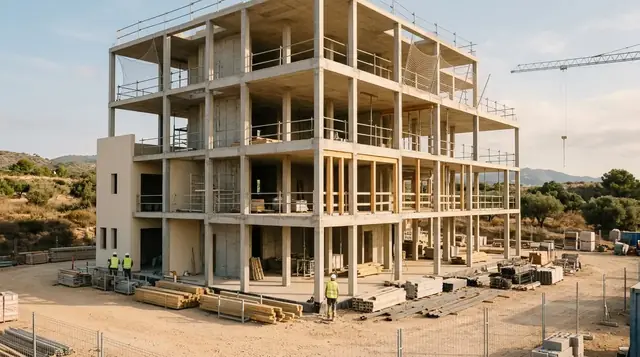
Turnkey fixed-price contract in Spain: what to include
What a fixed price really means on a building project, what the Spanish Civil Code says and which clauses a turnkey contract needs to protect you.
· 6 min read · Teciforp

A turnkey fixed-price contract in Spain (contrato llave en mano a precio cerrado) only protects you if the price rests on a detailed construction design (proyecto de ejecución) with a bill of quantities (mediciones). Without that document, "fixed" is just a word: anything the design does not define will end up as an extra.
Three ways to contract building work
| Contract type | How the price is set | Who bears the risk of overruns |
|---|---|---|
| Fixed price (lump sum, ajuste alzado) | One total figure for the work defined in the design | The contractor, as long as the design does not change |
| Measurement contract (por medición) | A price per unit of work; you pay for what is actually carried out | Shared: the unit price is fixed, the quantity is not |
| Cost-plus (por administración) | The actual cost of materials and labour plus a percentage | The developer (promotor) |
The Spanish Civil Code (Código Civil) covers the first two: work contracted by the piece or by measure, and work contracted for an agreed lump sum (por ajuste o precio alzado). The third is an industry practice, useful when the work cannot be defined in advance.
"Turnkey" (llave en mano) describes something else: the scope. It means that a single contractor hands over the building finished and ready for use. It can be combined with any of the three pricing methods, although it is usually paired with a fixed price.
What the law says about a fixed price
Article 1593 of the Civil Code sets the rule: whoever undertakes a building for a lump sum, on the basis of a plan agreed with the owner, cannot ask for more money even if wages or materials go up. They can do so when a change to the plan increases the work and the owner has authorised it.
Two practical consequences:
- A rise in the cost of materials is not an extra. Unless the contract says otherwise, the contractor absorbs it.
- Changes are extras, but only authorised ones. That is why every change must be approved in writing, with its price, before it is carried out.
The courts consider that this rule is not mandatory: the contract can include a price-revision clause (cláusula de revisión de precios). Read it before you sign. A "fixed-price" contract with an open-ended price revision is not a fixed price.
What the contract should include
- The detailed construction design as an annex. It is what defines what gets built.
- A budget broken down by item, with quantities. Each item (partida) with its quantity and its price.
- Specification of finishes (memoria de calidades). With brands and models, or with an equivalent standard that can be verified.
- Timeframe and schedule. Start date, intermediate milestones and handover date.
- Payment terms. Against valuations of work carried out (certificaciones de obra), not by calendar dates.
- Retention (retención de garantía). It is common to agree a percentage of each valuation that is held back and returned when the guarantee period ends.
- Penalty for delay. Together with the causes that exclude it.
- Change procedure. In writing, priced and approved before being carried out.
- Express exclusions. Licences and fees, utility connections (acometidas), furniture and equipment: included or excluded, but in writing.
- Insurance. Third-party liability and, where applicable, contractor's all-risks insurance (todo riesgo construcción).
- Acceptance of the works (recepción). How the acceptance certificate (acta de recepción) is signed and how reservations are dealt with.
- Final documentation. The certificate of completion (certificado final de obra), the legalisation of the installations (legalizaciones) and the rest of the as-built documentation.
What a fixed price does not cover
- Changes you ask for. A different layout, different finishes, more floor area.
- What could not be seen. In a refurbishment, the real condition of the structure or the building services only becomes known once things are opened up. This is reduced with prior exploratory openings and tests (catas y ensayos) and with a contingency item agreed from the outset.
- New requirements from the authorities while the licence application is being processed.
A good contract does not deny that these situations exist: it says how they will be priced when they arise.
Acceptance and guarantees
The Building Act (Ley 38/1999 de Ordenación de la Edificación, LOE) regulates two moments that you should be clear about.
Acceptance. This is the act by which the contractor hands over the finished works and the developer accepts them. It is recorded in a certificate, which may include reservations: defects that must be remedied within a set period. The liability periods start running from acceptance without reservations, or from the date on which the reservations are remedied.
The liability periods for physical damage to the building:
| Period | What it covers |
|---|---|
| 10 years | Damage that affects the structure and compromises the strength and stability of the building |
| 3 years | Defects in building elements or installations that fail to meet habitability requirements |
| 1 year | Workmanship defects affecting the finish or final detailing, for which the contractor is liable |
Claims become time-barred two years after the damage occurs.
These are the legal liabilities. The contract can add guarantees of its own. At Teciforp we insure our works for €1,200,000 and give a 2-year guarantee from handover.
Frequently asked questions
Can the price go up if materials go up?
No, unless the contract includes a price-revision clause. That is why it is worth reading it before you sign.
What happens if I want to change something during the works?
The change is priced, approved in writing with its price and its effect on the timeframe, and only then carried out. Never the other way round.
Does turnkey include the furniture?
It depends on what the contract says. In a hotel it is usual to include furniture and equipment so that the building is handed over ready to open, but this must be stated in writing.
What is a retention?
A percentage of each payment that the developer keeps until the agreed guarantee period ends, as security against possible defects.
Can you sign a fixed-price contract without a detailed construction design?
You can, but it is not advisable. Without quantities there is no way of knowing what the price includes, and anything left undefined turns into a dispute.
Sources
- Código Civil (Spanish Civil Code), articles 1588 to 1600, especially article 1593.
- Ley 38/1999, de 5 de noviembre, de Ordenación de la Edificación (Building Act of 5 November 1999), articles 6, 17 and 18.
This article is for information only and does not constitute legal advice. If you would like to see how we approach a building contract ourselves, take a look at our turnkey construction service.