Hotel construction phases in Spain: licence to opening
The seven phases of a hotel project, from feasibility to opening: what is decided in each, what the developer receives and where time is lost.
· 5 min read · Teciforp
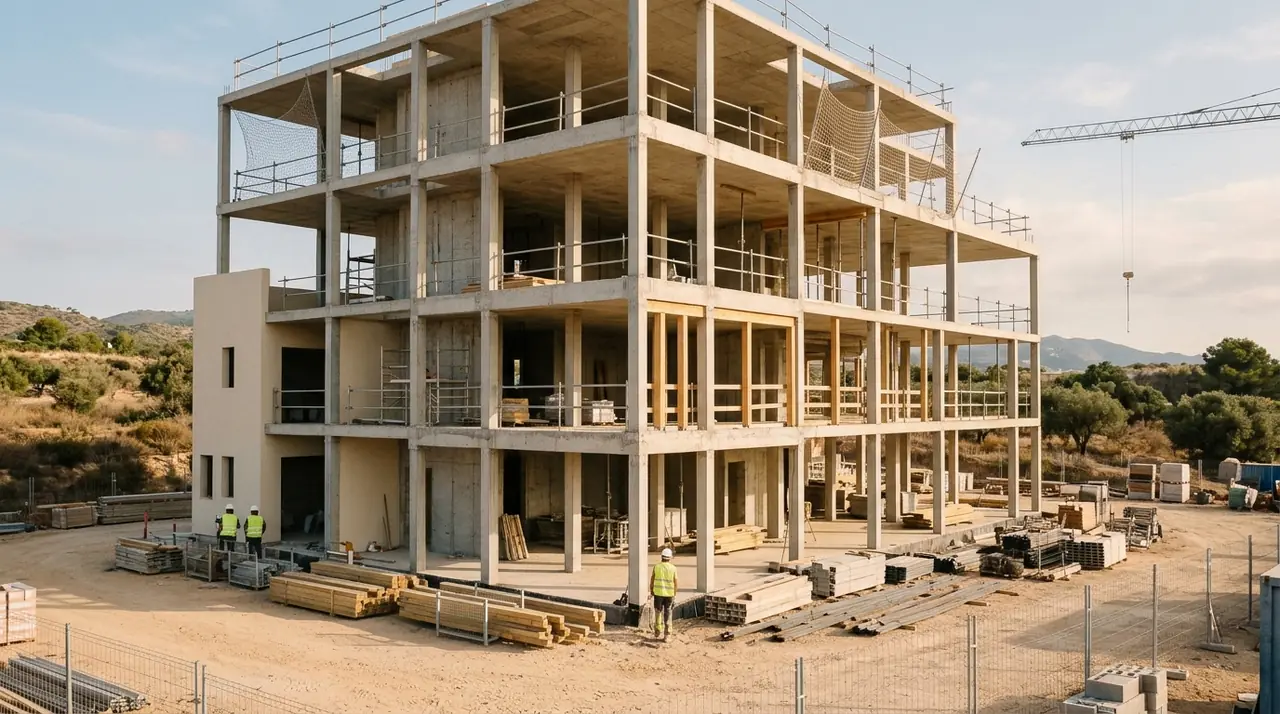
A hotel is built in seven phases, and only one of them is the construction work itself. The other six determine how long the whole process takes. Here are the hotel construction phases in order, what is decided in each one and what document you receive when it is complete.
We do not give fixed timeframes, because they depend on the town hall (ayuntamiento), on the size of the building and on whether it is a new build or a refurbishment. What is fixed is the order, and which phases can overlap.
The seven phases
1. Feasibility
This phase checks that hotel use is possible in the property, how many rooms will fit and what investment it involves. You receive a report on which to base the decision to go ahead or not. We explain it in detail in what a feasibility study analyses.
2. Basic design and licence
The basic design (proyecto básico) defines the building: layout, floor areas, volume and compliance with the regulations. It is what you submit to apply for the building licence (licencia de obras).
This is the phase you control least, because the timeframe depends on the authorities. What does depend on you is submitting a complete application: requests from the authorities for missing documents (requerimientos) are the most common delay, and the most avoidable.
3. Detailed design and contracting
The detailed construction design (proyecto de ejecución) goes down to construction detail and includes the bill of quantities (mediciones) and a budget broken down by item. It is the document on which the building contract is signed.
This phase can overlap with the processing of the licence. It is the main risk-free time saving available to a developer (promotor).
4. Construction
With the licence and the contract in place, the works begin, in this general order:
- Demolition and preliminary works.
- Structure and, in a refurbishment, structural reinforcement.
- Building envelope: façade, roof, and windows and external doors (carpinterías).
- Building services: heating and air conditioning, water, electricity, fire protection.
- Interior finishes.
During the works you receive periodic valuations (certificaciones): the work carried out, priced item by item.
5. Equipment and testing
Furniture, electronic locks, kitchen and laundry equipment, signage. In parallel, the installations are tested at full operation.
One practice that saves problems is to finish a pilot room first. Mistakes are then corrected once, rather than in every room.
6. Completion
The project's technical supervision team (dirección facultativa) signs the certificate of completion (certificado final de obra). The contractor hands over and the developer accepts in the act of acceptance (recepción), which is recorded in an acceptance certificate (acta de recepción). The liability periods under the Building Act (Ley 38/1999 de Ordenación de la Edificación, LOE) start running from that acceptance.
The installations are also legalised (legalizaciones), and the as-built documentation is assembled to form the Building Logbook (Libro del Edificio).
7. Opening
In the Comunitat Valenciana, the start of the accommodation business is notified to the tourism authority by means of a responsible declaration (declaración responsable). The authority classifies the establishment and enters it in the Tourism Register of the Comunitat Valenciana (Registro de Turismo de la Comunitat Valenciana).
On top of this come whatever municipal activity procedures apply in each town hall.
What the developer receives at each phase
| Phase | Who sets the pace | What you receive |
|---|---|---|
| Feasibility | You and your technical team | Feasibility report |
| Basic design and licence | The town hall | Building licence |
| Detailed design | The technical team | Design, quantities and signed contract |
| Construction | The contractor | Valuations and progress reports |
| Equipment and testing | Suppliers and installers | Building fitted out and tested |
| Completion | The technical supervision team | Certificate of completion and acceptance certificate |
| Opening | The tourism authority and the town hall | Classification and entry in the register |
Where time is lost
- In the licence, because of incomplete applications.
- In design changes once the works have started. Every change has a cost and a timeframe, and often requires the licence to be amended.
- In long-lead supplies. Lifts, air-conditioning equipment and made-to-measure windows and doors are ordered well before they are needed on site.
- In the utility connections for electricity and water, which depend on the utility companies.
- In the final legalisations, if they have not been prepared during the works.
How to save time without taking on risk
- Draw up the detailed construction design while the licence is being processed.
- Decide on the category and the equipment early: they shape the building services and the layout.
- Order long-lead equipment as soon as the design is finalised.
- Complete a pilot room before repeating the finishes throughout the building.
- Prepare the legalisations during the works, not at the end.
Frequently asked questions
Can work start before the licence is granted?
No. Without the permit that authorises the works (título habilitante), work cannot begin. What can be brought forward is the detailed construction design and the contracting.
What is the difference between the basic design and the detailed construction design?
The basic design defines the building and is used to apply for the licence. The detailed design develops the construction detail and the quantities, and is used to build and to contract the works.
When does the guarantee period start?
From acceptance of the works without reservations, or from when the reservations noted in the acceptance certificate have been remedied.
Can I open as soon as the works are finished?
First the installations have to be legalised and the responsible declaration submitted to the tourism authority, in addition to whatever municipal procedures apply.
Sources
- Ley 38/1999, de 5 de noviembre, de Ordenación de la Edificación (Building Act of 5 November 1999), articles 6, 7 and 17.
- Código Técnico de la Edificación (Technical Building Code).
- Decreto 10/2021, de 22 de enero, del Consell (Decree 10/2021 of 22 January of the Valencian regional government), the regulation governing tourist accommodation in the Comunitat Valenciana. Always check the version currently in force.
This article is for information only and does not constitute legal advice. If you have a building or a plot in Alicante, we'll tell you what can be built.