Renovating a house in Altea old town: rules and permits
What you can and cannot change in the protected old town of Altea: heights, roofs, joinery, heritage permit, building licence, taxes and summer bans.
· 13 min read · Teciforp
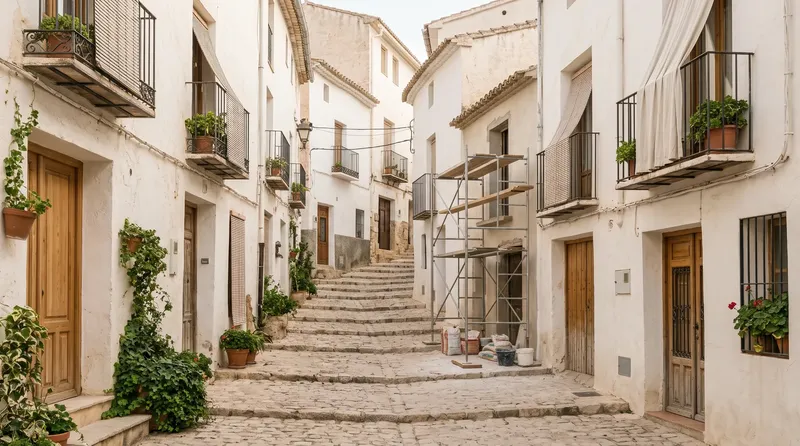
Yes, you can renovate a house in Altea old town, but not the way you would renovate any other house. The walled quarter at the top of the hill is a protected heritage site, and that settles three things before you choose a builder: what may change on the outside (very little — heights, roof, openings and joinery are fixed by decree), who signs off the works (the town hall and, where the works affect the heritage, the regional culture department first) and when you may build (from 16 July to 31 August no noisy works are allowed anywhere in the municipality). This guide sets those three things out with the documents behind them.
This is general information as at 19 November 2026, not legal or tax advice. Before you buy or commission a design, ask the planning office (Urbanismo) for the status of your plot.
The Spanish terms you will meet
- BIC (Bien de Interés Cultural) — the highest level of heritage protection in Spain. Altea old town is a BIC in the category of historic ensemble (conjunto histórico), roughly what a British buyer would call a conservation area with listed-building controls.
- Conselleria — a department of the regional government (Generalitat Valenciana). The one responsible for culture authorises works in a BIC.
- Licencia — a building licence granted by the town hall (Ayuntamiento). Declaración responsable — a statement of compliance you file instead of a licence for lighter works; you take responsibility that the works comply.
- ICIO — the municipal tax on construction works. Tasa — the municipal fee for processing the permit.
Which part of Altea is protected, and by what
The rule is Decree 69/2013 of 7 June of the Consell, which declares the «Baluarte y Recinto Renacentista de la Villa de Altea» — the bastion and Renaissance walled precinct — a BIC. Three points to get your bearings:
- The boundary is drawn by cadastral blocks, not by what estate agents call the old town. The blocks are listed in the annexes to the decree, with a plan. The first check is whether your cadastral reference falls inside, in the protection zone around the walls — which are a monument in their own right — or outside.
- Some houses have full protection by name and number: Calle Salamanca 1, 3 and 5, Calle Honda 8, Calle Concepción 5 and the façade of the Casa Cervantes at Santa Bárbara 8 (article 6).
- The decree is a transitional regime until the town approves the special protection plan (Plan Especial de Protección) required by the Valencian cultural heritage law (article 34.2). On 17 July 2026 the regional planning commission gave final approval to a new general plan for Altea (Plan General Estructural), replacing the 1982 plan, according to the town hall note reported by elperiodic.com; that note does not mention the historic ensemble, and we have not found an approved special plan in print. Ask the planning office whether anything has changed.
For the municipality as a whole — hillside villas, licences outside the old town — see our page on building and renovation in Altea.
Which permit each type of work needs
Inside the historic ensemble there are two desks. The municipal one follows Altea's planning permissions ordinance (provincial gazette, BOP No. 149 of 5 August 2024). The regional one is heritage: until there is a special plan, any work of heritage significance needs authorisation from the culture department before the licence (article 2 of the decree). The law gives the department three months to decide and, if it does not reply, the authorisation is deemed refused (article 35.2 of Law 4/1998).
| Works | Municipal permit | Prior heritage authorisation? |
|---|---|---|
| Internal refurbishment that does not change the exterior: layout, kitchen, bathrooms, services | Declaración responsable, as works without heritage significance in a protected building (art. 32.1) | No, if the municipal officer reports them as not significant; the town hall notifies the department within 10 days |
| Repair or like-for-like replacement of what already exists in the envelope: re-tiling with the same tile, re-rendering, repairing joinery | Declaración responsable | The decree exempts it from prior authorisation |
| Changing openings, roof, façade or volume; replacing main structure; adding a storey | Intervention licence (licencia de intervención), three months to decide (art. 53) | Yes, before the licence |
| New build on a vacant plot, or demolition | Building licence | Yes |
| Change of use | Licence, two months to decide (art. 48) | Depends on the scope of the works |
| Scaffolding, crane or occupying the street | Licence: it is work on public land (art. 41) | The decree requires authorisation for anything affecting the street scene, including occupation of the public road (art. 5) |
| Digging or disturbing the subsoil | Whatever the works require | Archaeological watching brief across the whole precinct (art. 10) |
Three practical details from the ordinance:
- A declaración responsable must include proof that the fee and tax have been paid, a detailed budget, the start date and duration, the sector authorisations — cultural heritage among them — and, if the works budget exceeds 20,000 euros, a 3% guarantee. For residential buildings over 50 years old it also asks for the building evaluation report (articles 33 and 35).
- Under a declaración responsable the works must start within one month and finish within the period you state, with a maximum of 24 months. Under a licence, unless it says otherwise, you have six months to start and 24 to finish (article 16).
- The intervention licence requires a measured survey at 1:50, a full photographic record and a statement showing how the protection rules are met (article 53).
Skipping the heritage desk is expensive: works carried out without authorisation are illegal, demolition or reconstruction can be ordered at the offender's cost, and the developer, the builder and the technical director are jointly liable (article 37 of Law 4/1998).
The design rules that are not up for negotiation
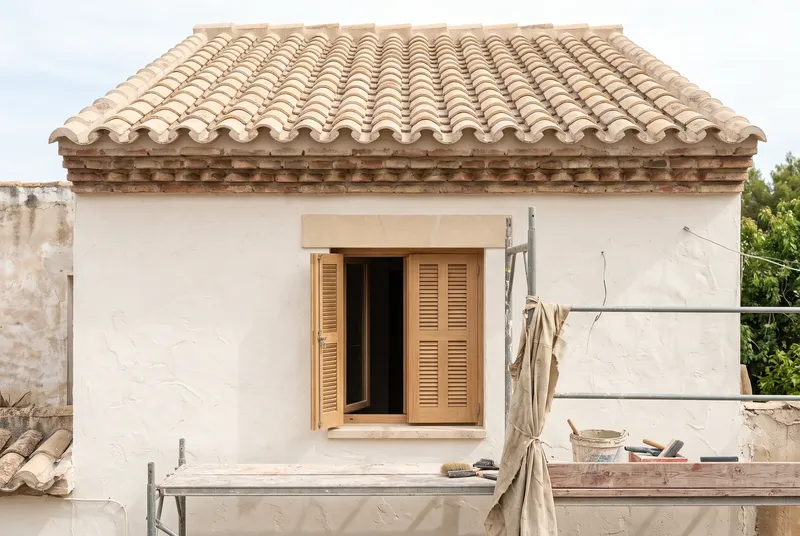
Article 6 of the decree works as a closed design code. The essentials:
| Element | What the decree fixes |
|---|---|
| Plot and building line | The historic plot pattern is kept; no setbacks and no courtyards open to the street |
| Height | New build or added storeys: 7.30 m for three floors (ground, first and attic storey, the «cambra») or 5.40 m for two. Buildings from before 1940 keep their present height |
| Below ground | No semi-basements; the ground floor at most 19 cm above street level |
| Roof | Pitched on two sides, in white-clay curved tile; pitch of 30 to 35% and a ridge no more than 1.80 m above the cornice |
| Eaves | Solid brick in traditional forms |
| Openings and balconies | Vertical openings; balconies with metal railings, projecting no more than 35 cm and no longer than 1.80 m; no enclosed bay windows; traditional ironwork is kept |
| Joinery | Timber in every external opening; blinds only of the traditional roll-up or Mallorcan louvred type |
| Finish | Lime or mixed mortar render, whitewashed; blue or red-ochre wash only on the reveals |
| Advertising | Prohibited, except a sign giving the name of the building or business |
Two consequences worth seeing before you buy. First: enclosed overhangs, terraces and other out-of-keeping elements are classed as non-conforming (fuera de ordenación, article 7); what exists today in that form cannot be taken as secure in a refurbishment. If the house you are viewing owes its sea view to a glazed-in balcony or a roof terrace cut into the tiles, find out its status before you price it in. Second: the decree says nothing explicit about air-conditioning units or solar panels, and the Valencian heritage law makes aerial installations in these areas subject to authorisation. Anything visible from the street belongs in the design, not at the end of the job.
What you pay the town hall
There are two charges, both on the construction cost (presupuesto de ejecución material), excluding VAT, professional fees and the contractor's profit:
- ICIO: 3.5%, under the tax ordinance published in the BOP of 3 September 2024. You self-assess and pay it before the licence is granted, and it is adjusted to the real cost on completion.
- Planning fee: 2.09%, with a minimum of 6.28 euros, under the fee ordinance.
An example for a full refurbishment with a construction cost of 180,000 euros:
| Item | Calculation | Amount |
|---|---|---|
| ICIO | 180,000 × 3.5% | €6,300 |
| Fee | 180,000 × 2.09% | €3,762 |
| Total charges | €10,062 | |
| Guarantee (if filed as a declaración responsable) | 180,000 × 3% | €5,400 |
The ICIO ordinance has reductions that matter in the old town: 95% for the rehabilitation of buildings in the municipal catalogue of protected assets when the works cover the whole building and aim to recover it, 50% for other works at protection levels A and B, and 35% at level C. At 95%, the ICIO in the example would fall to 315 euros. Two conditions: you apply beforehand and the full council declares it; and being inside the historic ensemble is not the same as having a level in the catalogue, so check the entry for the property. There is also 95% for non-mandatory solar installations and 90% for accessibility works.
When you can build: Altea's calendar
The working-hours ordinance for building sites (BOP No. 158 of 18 August 2016) is the kind that reshapes a programme:
| Period | Non-noisy works | Noisy works |
|---|---|---|
| Rest of the year | Monday to Friday 8:00–20:00; Saturdays 9:00–14:00 | Heavy machinery, Monday to Friday 8:00–14:00 and 15:30–17:30 |
| 15 June to 15 July | 8:00–16:00 | 9:00–14:00 |
| 16 July to 31 August | 8:00–16:00 | Not permitted |
| 1 to 15 September | 8:00–16:00 | 9:00–14:00 |
Noisy works are earthmoving, excavation, structural work and demolition. Demolition on urban land is not authorised at any point in the summer period, and demolition already under way must stop. Interior work without machinery — electrics, plumbing, painting, joinery — continues all year. In the old town, works also stop at Christmas, Easter and during the local fiestas, with the street left clear. The time lost does not count against the validity of the licence, and fines run up to 3,000 euros.
For an old-town house, where almost everything is carried by hand along narrow lanes and skips may not stay on the street over the weekend, the conclusion is simple: roof, structure and internal demolition between mid-September and mid-June; summer for services and finishes. If you plan to use the house yourself in summer, that also means a refurbishment started in spring will not be finished for that season.
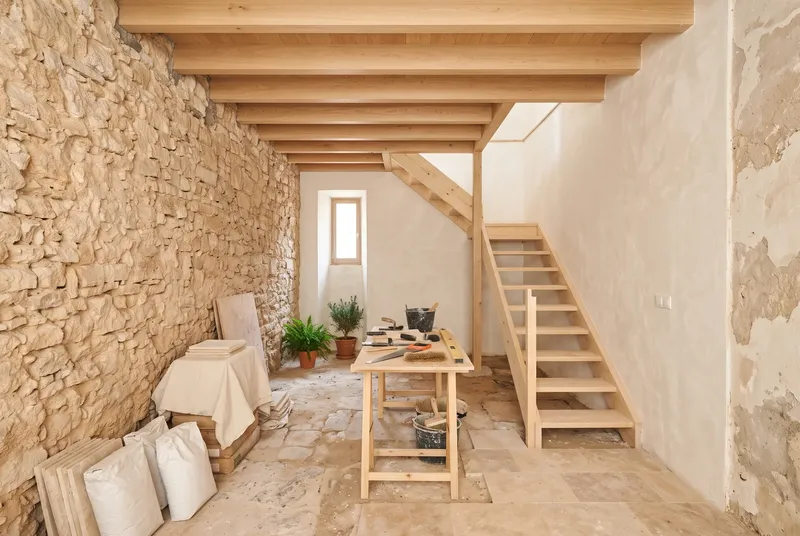
The order that avoids lost months
- Place the house: inside or outside the boundary, protection zone of the walls, full protection, year of construction.
- Technical survey: structure, roof, damp, non-conforming elements. What to look for in an old building is in our guide to the stages of a full building renovation.
- Agree the scope with the municipal officer: what can go by declaración responsable and what needs the culture department. It is the decision that moves the timetable most.
- Design with the heritage study and the application to the culture department, if needed. Allow up to three months.
- Licence or declaración responsable, with ICIO, fee and, where it applies, the tax reduction requested in advance.
- A programme built around the summer: noisy works outside 16 July to 31 August.
If you have not bought yet, this route is walked before you sign; it is the work we do in our property search and pre-purchase checks service. And if you are thinking of holiday lets, do not take them for granted: according to Alicante Plaza, the ordinance the full council approved in January 2026 caps tourist flats at 12% of the housing stock and leaves the traditional historic core only an exception tied to the full rehabilitation of the building. Confirm the text in force with the town hall.
Teciforp carries out full refurbishments and whole-building renovation; we do not take on small one-off jobs. If you own or are about to buy a house in Altea old town, call us on +34 602 510 710: on the call we will tell you whether it is a job we take on, where to start and what documents to prepare. How we work is on our pages on building renovation and full home renovation.
Frequently asked questions
Do I need heritage consent to refurbish the inside of my house?
Not always. The decree allows the town hall, on a reasoned technical report, to exempt from prior authorisation internal works that do not affect how the building is seen from outside, in properties without individual protection. Those works go by declaración responsable and the town hall notifies the culture department within ten days.
Can I fit aluminium or wood-effect uPVC windows?
The decree requires timber joinery in every external opening and allows only traditional roll-up or Mallorcan louvred blinds. It provides no exception for imitation materials; any other solution would have to be put to the culture department with the design.
Can I add another storey?
Only within the caps: 7.30 metres for three floors or 5.40 for two, with the number of floors the planning rules set for each plot. Buildings from before 1940 keep their present height. It is work of heritage significance: authorisation from the culture department, then a licence.
How long does the permit take?
The culture department has three months, and silence means refusal. The municipal intervention licence has another three. An internal refurbishment under a declaración responsable does not wait for a decision, but must start within a month of filing.
Can building work be done in August in Altea old town?
Only non-noisy work, from 8:00 to 16:00, and interior work without machinery. Earthmoving, structural work and demolition are banned from 16 July to 31 August throughout the municipality.
How much is the construction tax in Altea?
3.5% of the construction cost, plus a fee of 2.09%. Buildings in the catalogue of protected assets may qualify for reductions of 35 to 95% on the tax, which must be applied for in advance.
Sources
- Decree 69/2013 of 7 June of the Consell, Bien de Interés Cultural, historic ensemble of the Baluarte y Recinto Renacentista de la Villa de Altea (BOE No. 156 of 1 July 2013): boe.es
- Law 4/1998 of 11 June on Valencian Cultural Heritage, consolidated text (articles 34 to 37): boe.es
- Altea Town Hall, Ordenanza Municipal Reguladora de las Autorizaciones Urbanísticas (BOP No. 149 of 5 August 2024): cdn.digitalvalue.es
- Altea Town Hall, tax ordinance for the Impuesto sobre Construcciones, Instalaciones y Obras (BOP No. 169 of 3 September 2024): cdn.digitalvalue.es
- Altea Town Hall, fee ordinance for planning licences and related procedures: cdn.digitalvalue.es
- Altea Town Hall, ordinance on working hours, cleanliness and safety of building works (BOP No. 158 of 18 August 2016): cdn.digitalvalue.es
- elperiodic.com, «Altea inicia una nueva etapa con la aprobación definitiva de su Plan General Estructural» (17 July 2026): elperiodic.com
- Alicante Plaza, «Altea endurece las condiciones para las viviendas turísticas en una nueva versión de la ordenanza» (25 January 2026): alicanteplaza.es